Bisociation Thinking Triggers Creative Flow: How Colliding Disparate Ideas Creates Deep Engagement
Discover how Arthur Koestler's bisociation concept merges with flow theory to create a powerful technique for creative immersion through colliding ideas from different domains.
What Is Bisociation — The Critical Difference from Ordinary Association
Our everyday thinking operates through association. When you hear "marketing," related concepts immediately surface: advertising, targeting, conversion. This is thinking that proceeds within a single logical framework, or what Arthur Koestler called a "matrix." While efficient, this mode of thought produces only incremental ideas that extend existing patterns.
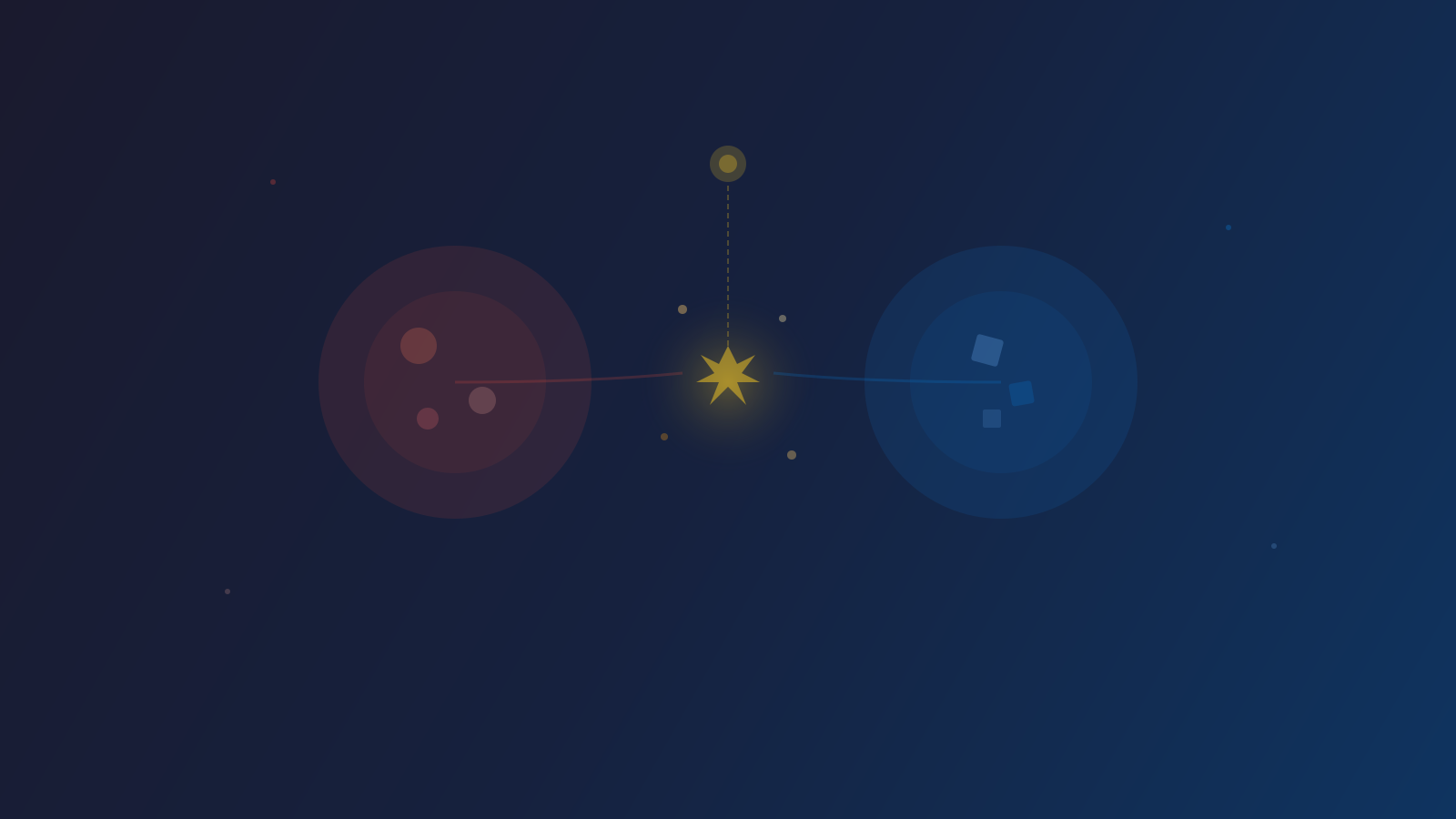
Bisociation, the concept Koestler introduced in his 1964 book "The Act of Creation," is fundamentally different. It involves simultaneously holding two distinct frameworks and discovering new meaning at their intersection. Gutenberg, for instance, collided "wine press mechanics" with "letter reproduction" to invent the printing press. Darwin connected "Malthus's population theory" with "observations of plants and animals" to arrive at natural selection.
According to Koestler's research, scientific discovery, artistic creation, and humor all share this bisociative structure. A joke is funny precisely because the listener is proceeding along one interpretive framework when a completely different one suddenly intrudes. This "collision of alien frameworks" is an intensely stimulating experience for the brain — and it functions as a gateway to flow state.
Three Mechanisms by Which Bisociation Triggers Flow State
The relationship between bisociation and flow can be explained through three neuroscience-backed mechanisms.
First, the cognitive load of simultaneously maintaining two different domains creates an "optimal challenge" for the brain. This automatically satisfies the core flow condition of skill-challenge balance. Thinking within a single domain is often too easy, leading to boredom, while juggling three or more domains simultaneously creates overwhelming confusion. But exploring the intersection of exactly two domains sits at the sweet spot of difficulty. Research at Northwestern University has confirmed that when people engage in moderately complex cognitive tasks, activity in the prefrontal cortex and temporal lobe synchronizes, producing brainwave patterns characteristic of flow states.
Second, the moment of bisociation — the "aha experience" when two different concepts connect — triggers a sharp release of dopamine in the brain. Research by Professor Mark Beeman at Drexel University shows that at the moment of insight, gamma waves surge in the anterior superior temporal gyrus while the reward system simultaneously activates. This reward signal creates what flow theory calls an "autotelic experience" and strengthens intrinsic motivation to explore further. In other words, bisociation forms a self-reinforcing loop that automatically generates the desire for more once it begins.
Third, the collision of disparate ideas generates unpredictable developments. The uncertainty of not knowing what will emerge next strongly anchors attention to the current thought process. This aligns perfectly with flow's characteristic "complete immersion in the present." In game design, this "optimal balance between predictability and uncertainty" is recognized as the primary factor drawing players into flow — and bisociation thinking reproduces this exact structure within the thinking process itself.
Bisociation Flow Exercises — Three Practical Methods
With the theory understood, here are concrete exercises for experiencing flow through bisociation.
Exercise 1: Random Connection Method (15 minutes) Choose two completely unrelated concepts. Open a dictionary randomly to select words, or create "industry × different field" combinations such as "accounting × jazz," "healthcare × game design," or "education × architecture." Write at least 10 commonalities between these two concepts. The first three will be superficial, but from the seventh onward, you'll begin discovering deep structural similarities. For "accounting × jazz," initial connections might be as simple as "both involve numbers," but deeper exploration reveals insights like "improvisation exists within rules" and "intuition for sensing overall balance is essential." During this digging process, thinking accelerates and ideas begin flowing continuously — a genuine flow experience emerges.
Exercise 2: Cross-Industry Input Method (weekly, 60 minutes) Spend 60 minutes consuming books, articles, or videos from a field completely different from your expertise. If you're a programmer, read a book on pottery. If you're a marketer, try an introduction to quantum physics. If you're a teacher, watch a cooking YouTube channel. While consuming this input, continuously ask yourself: "How could this apply to my work?" You might understand the essence of software refactoring through pottery's clay-kneading process, or rediscover the importance of lesson preparation through cooking's mise en place. The key is searching not for immediately applicable knowledge but for similarities in structure and process. Professor Tina Seelig at Stanford has demonstrated that this kind of "distant analogy" generates the most innovative ideas.
Exercise 3: Forced Collision Brainstorming (30 minutes) Choose one problem you want to solve and apply rules from a completely unrelated world. "How would a chef solve this problem?" "How would I explain this to a five-year-old?" "If this situation were a soccer match, what would it look like?" The act of thinking within constraints creates flow's "clear goals" condition, while searching for answers from alien perspectives provides the skill-challenge balance. IDEO's design thinking methodology has also adopted this "forced perspective shift" as a technique for generating breakthroughs. Within a 30-minute session, you'll generate at least one completely unexpected solution.
Bisociation and Flow in Historical Innovation
The flow experience triggered by bisociation appears abundantly in the testimonies of history's greatest innovators.
Steve Jobs spoke about how taking a calligraphy class at Reed College later led to the beautiful typography of the Macintosh. When the two alien worlds of technology and calligraphy collided, Jobs experienced what he described as "connecting the dots." His oft-repeated statement that "creativity is just connecting things" is a concise expression of bisociation's essence.
Biologist James Watson recalled being in an extraordinary state of concentration in the weeks before discovering DNA's double helix structure. Through repeated experiments combining X-ray diffraction data with metal model building, two frameworks — chemical bonding rules and three-dimensional structural constraints — collided, and the idea of a "helix" suddenly emerged. This discovery process is a textbook example of bisociation leading to breakthrough through flow state.
Architect Tadao Ando, who taught himself architecture, brought his boxing experience into architectural design. His design philosophy of "light and shadow fighting within space" was born from the bisociation of two utterly different worlds: martial arts and architecture. The deep flow state he experiences when immersed in design is inseparable from the intellectual excitement generated by this collision of disparate elements.
Building Systems to Make Bisociation a Habit
Bisociation thinking is like a muscle — it grows stronger with use. Here are systems for training this thinking method in daily life.
First is "boundary-crossing reading." Always read two books in parallel: one in your field and one from a completely different domain. When you find connection points between them, record them in a notebook. For example, reading a management book and an ecology book simultaneously might reveal deep structural similarities between "organizational resilience" and "ecosystem recovery capacity." These "crossing notes" become seeds for creative flow. Bill Gates's annual "Think Week," where he intensively reads books from multiple fields, is one form of this boundary-crossing reading practice.
Second is "cross-field lunches." Once a month, have lunch with someone whose work is completely different from yours. While listening to their work stories, search for commonalities with your own. When bisociation occurs during dialogue, a deep conversational flow emerges where time disappears. Research at the MIT Media Lab has also reported that serendipitous conversations between researchers from different fields are often the origin of the most innovative research projects.
Third is "daily two-word combinations." Spend five minutes each morning creating one idea that connects two unrelated things you see. "Coffee cup × train" becomes "a cup that maintains optimal temperature during commutes." "Rain × presentation" becomes "a presentation method where information gradually permeates." It doesn't matter if they seem silly. This small habit expands the brain's associative network, creating the foundation for creative flow to strike at unexpected moments.
The Long-Term Transformation That Bisociation Thinking Creates
When bisociation thinking is practiced continuously, cognitive patterns in the brain itself begin to change. Creativity research at the University of California reported that subjects who consciously practiced connecting knowledge from different fields for six weeks showed an average 40 percent improvement in divergent thinking test scores.
Even more significant is that habituating bisociation thinking makes entering flow state progressively easier. Initially, conscious effort is required to collide two domains together. But with practice, the brain begins automatically connecting disparate information. Moments of realization — "this is similar to that other field" — start occurring naturally in daily life, and each such moment triggers a small flow state.
Bisociation thinking is not merely an idea generation technique. It is a cognitive framework that fundamentally changes how you see the world. By honing the ability to build bridges between disparate things, your thinking becomes more flexible, deeper, and more conducive to immersion. Ideas born through flow experiences arrive from realms of creativity that logic alone cannot reach. Start today by connecting two unrelated things in front of you. That small step opens the door to creative flow.
About the Author
Flow Theory Editorial TeamWe share the science of flow in a way that is easy to understand and applicable to modern life.
View author profile →Related Articles
Exploratory Goal Design Creates Flow: Goal-Setting for an Uncertain World
The Flow Cycle for Video-Based Mastery: Watch, Imitate, and Transcend in Three Steps
Enter Flow Through Inquiry-Based Reading: Transform Passive Reading into Deep Immersion
Flow Routine Design for Night Owls: How to Achieve Deep Engagement Beyond the Early Bird Myth