Enter Flow Through Creative Journaling: The Art of Immersion Through Writing and Drawing
Discover how creative journaling—combining writing and visual expression—triggers flow through three mechanisms, with practical methods for bullet journaling, visual thinking, and collage diaries.
Three Mechanisms by Which Creative Journaling Induces Flow
The first reason creative journaling easily triggers flow is "multimodal attention integration." Writing activates the brain's language areas—Broca's area and Wernicke's area in the left hemisphere—while drawing activates visuospatial cognition regions in the right hemisphere. Using these two cognitive modes alternately or simultaneously forces the brain to commit more cognitive resources to the current activity. A 2017 study by Professor Kaplan and colleagues at Drexel University reported that 45 minutes of art-making significantly reduced participants' cortisol (stress hormone) levels while simultaneously increasing prefrontal cortex activity. The result is no room for stray thoughts, naturally achieving "complete concentration of attention"—the core condition of flow state.
The second reason is "immediate visual feedback." In creative journaling, shapes and colors appear on the page with every pen stroke. This visual feedback is immediate and clear, perfectly satisfying flow's "immediate feedback" condition. Color use particularly activates the brain's dopamine reward circuit, naturally generating intrinsic motivation of "wanting to continue a bit more." This operates on the same mechanism as wanting to advance to the next level in a game. Moreover, since journaling's feedback originates from your own hand, it becomes a sustainable motivation that doesn't depend on external rewards.
The third reason is "infinitely expanding challenge levels." You can start with simple bullet points and basic shapes, then expand skills endlessly into lettering, watercolor sketching, collage, mind mapping, and calligraphy. In Csikszentmihalyi's flow theory, flow state occurs when skill level and challenge level are in balance. The remarkable advantage of creative journaling is that as your skills improve, the complexity of expression naturally increases, automatically maintaining this balance. This "there's always a next level" structure sustains challenge-skill balance long-term, creating a flow activity you'll never tire of even after years.
The Science Behind Journaling's Psychological Benefits
The benefits of creative journaling aren't merely anecdotal—they're backed by rigorous scientific research. Professor James Pennebaker at the University of Texas has demonstrated through over 30 years of research on expressive writing that the act of putting emotions and thoughts into written words contributes to improved immune function, stress reduction, and enhanced cognitive processing.
Furthermore, the act of handwriting itself exerts unique effects on the brain. A research team led by Professor Van der Meer at the Norwegian University of Science and Technology found in experiments comparing handwriting and typing that handwriting activates broader brain regions, proving more effective for memory consolidation and creative thinking promotion. The very sensation of gripping a pen and feeling ink glide across paper activates the circuit connecting brain and body.
Creative journaling adds the power of visual expression to these expressive writing benefits. A 2016 study published in the Journal of Positive Psychology reported that participants who engaged in everyday creative activities (such as drawing and writing) experienced significantly elevated positive emotions the following day. In other words, creative journaling provides not only "in the moment" flow experiences but also positive impacts on mental health in the days that follow.
Three Creative Journaling Practice Methods
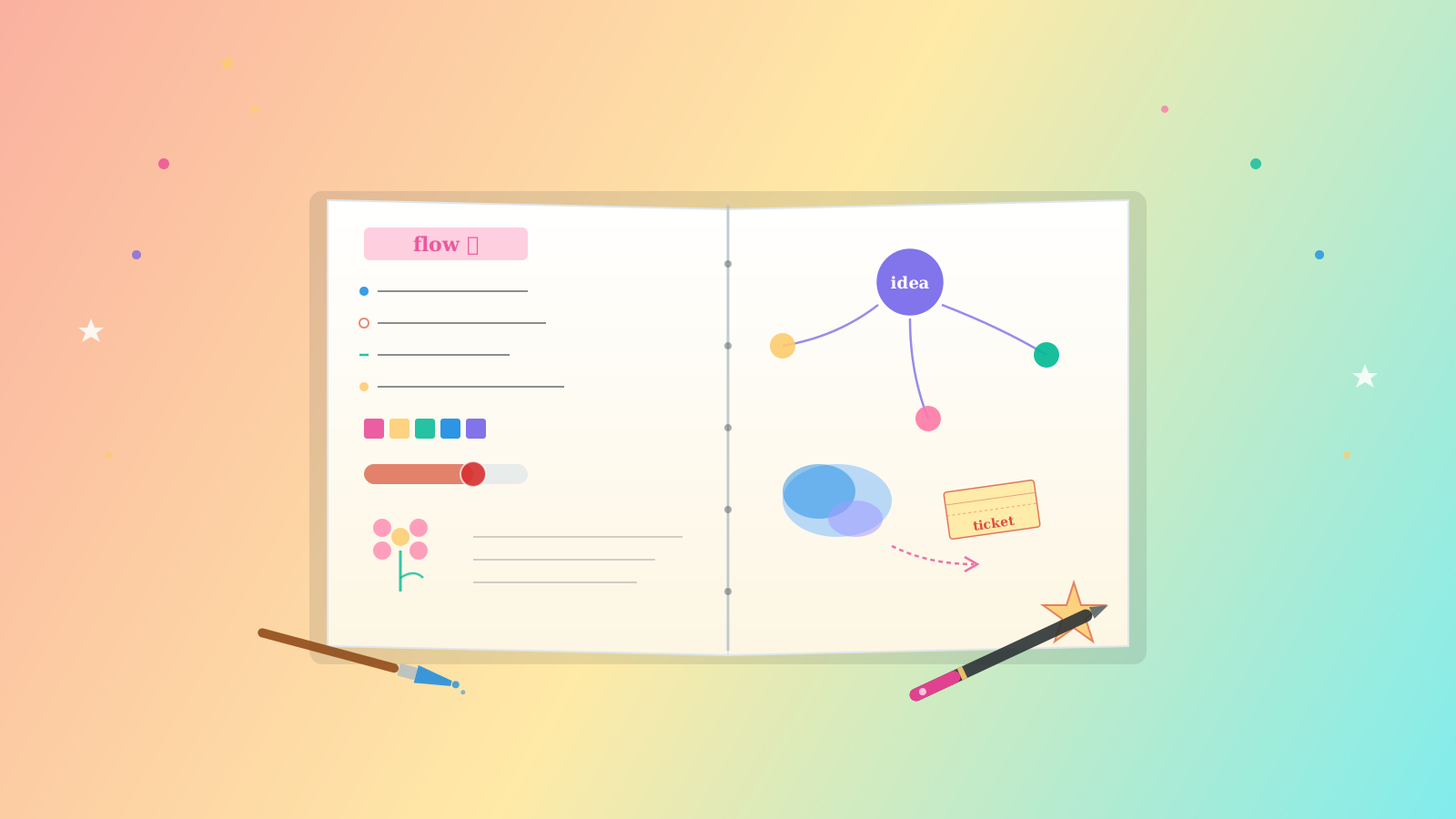
The Bullet Journal Flow Method fuses task management with creative expression. Using basic bullet journal symbols (• for tasks, ○ for events, — for notes) while setting theme colors for each page and decorating headings with lettering. For a concrete approach, start by creating a monthly page and selecting one theme color for that month. Then on weekly pages, decorate headings with hand lettering and add small icons beside each task. Develop your own rules—coloring in completed tasks, adding mini illustrations to important appointments. This "functionality + aesthetic expression" combination transforms mere task management into immersive experience. The key is not seeking perfection in decoration. Prioritizing "enjoying writing" over "writing beautifully" fades self-consciousness, facilitating flow entry.
The Visual Thinking Journal Method expresses thoughts through diagrams rather than text. For example, representing today's emotions on a thermometer illustration, organizing workplace challenges in flowcharts, summarizing key points from a book in mind maps, or sketching the day's events in a four-panel comic style. The process of visualizing thought itself produces strong immersion. A recommended starting approach for beginners is using a two-page spread: list the day's events in bullet points on the left page, then select one item to diagram on the right page. What matters isn't "drawing well" but "externalizing thoughts." Stick figures are fine. Circles, triangles, and squares work. Visual vocabulary naturally expands the more you practice.
The Collage Diary Method pastes magazine clippings, ticket stubs, favorite photos, wrapping paper scraps, and shop cards into a notebook, writing text around them. A practical tip is to maintain a "materials box" in daily life. Place interesting paper scraps, tickets, and receipts in a small box, then select from it during journaling time. Selecting materials, considering placement, gluing them down, adding words in margins—this entire process simultaneously engages touch (cutting and pasting), vision (deciding layout), and language (writing), creating deep immersion. Physical hands-on work particularly heals digital fatigue, providing an analog-specific immersion experience.
Creating the Optimal Journaling Environment for Deeper Flow
Environmental preparation is a crucial factor for entering flow state through creative journaling. Csikszentmihalyi noted that freedom from external interruption is essential for flow experiences. First, place your smartphone in another room or set it to airplane mode. A single notification vibration can break concentration and obstruct the transition to flow state.
Lighting deserves attention as well. Warm indirect lighting maintains a better balance of relaxation and focus than harsh fluorescent lights. Illuminating only your workspace with a desk lamp naturally narrows your visual field to the notebook, creating an environment conducive to immersion.
Regarding sound environment, research suggests that moderate ambient noise—such as café sounds or nature sounds—enhances creativity more than complete silence. Professor Ravi Mehta and colleagues at the University of Chicago demonstrated that ambient noise around 70 decibels most effectively promotes creative thinking. However, music with lyrics interferes with language processing, so it's best avoided during journaling.
Time of day selection also matters. Many researchers point out that creative activities suit slightly fatigued states—so-called "non-optimal time periods." Morning people may benefit from evening sessions, while night owls might try morning sessions, as weakened analytical thinking allows freer ideation. Experiment with different times to discover your optimal journaling window.
Tips for Making Creative Journaling a Daily Habit
The most important tip for making flow-producing creative journaling a daily habit is "set a time and start short." Every evening for 15 minutes, open your notebook after dinner. Focus only on these 15 minutes. No need to complete anything—stopping midway is fine. Continue the next day. This "incomplete completion" leverages the Zeigarnik effect—the psychological phenomenon where unfinished tasks are remembered better than completed ones—to maintain next-day motivation, producing natural continuation.
For habit formation, "trigger setting" proves highly effective. For example, linking "when I brew coffee, I open my notebook" or "after my bath, I sit at my desk" attaches the new behavior to an existing habit. In the "Tiny Habits" method proposed by behavioral scientist Professor BJ Fogg, placing a new small action immediately after an existing habit enables habit formation without relying on willpower.
Tool preferences also aid immersion. A smooth-writing pen, a textured notebook, a favorite set of colored pens—merely touching tools begins the brain's preparation for "journaling time." This is what psychology calls the "priming effect," where tools function as gateways to flow state. However, starting with whatever pen and notebook you have is sufficient. Letting tool collection become the goal and preventing you from starting defeats the purpose.
Additionally, establishing a weekly "review page" habit proves highly effective. Look back through the week's pages, mark those where you were particularly immersed, and analyze why you entered flow during those sessions. This reflective practice deepens understanding of your personal flow conditions and elevates the quality of future journaling sessions.
Opening the Door to Flow Through Writing
The essence of creative journaling is "having your own expression space." No need to share on social media, no need to show anyone. In a space completely free from others' evaluation, weaving thoughts and feelings through words and visuals—this completely autonomous creative act produces the deepest form of flow state.
Self-determination theory, proposed by psychologists Edward Deci and Richard Ryan, holds that three basic needs are essential for intrinsic motivation: autonomy, competence, and relatedness. Creative journaling is a rare activity that satisfies all three—"autonomy" in deciding what to write and draw, "competence" in feeling skill improvement, and "relatedness" through dialogue with your own inner self.
When you open that first page, there's no need to create something perfect. Drawing a single line, writing a single word—that alone begins creative journaling. What matters is the very act of picking up a pen and facing your notebook. That small step will eventually guide you into deep flow experiences. Through daily journaling, discover your own unique gateway to flow state.
About the Author
Flow Theory Editorial TeamWe share the science of flow in a way that is easy to understand and applicable to modern life.
View author profile →Related Articles
How Progressive Overload Produces Flow State: Designing Training Loads for Deep Immersion
Trust Your Intuition to Enter Flow: The Deep Connection Between Intuitive Decision-Making and Flow State
Solo Brainstorming for Creative Flow: How to Enter a State Where Ideas Never Stop
How a Daily Decluttering Habit Creates Flow: Why Letting Go Sharpens Your Focus