Enter Flow Through Pixel Art: How Tight Constraints Unleash Creative Immersion
Learn how pixel art naturally satisfies the flow conditions—finite canvas clarity, instant per-pixel feedback, and endless expressive possibility—and how 16×16 challenges, palette restrictions, and a one-piece-a-day habit turn creative immersion into a daily ritual.
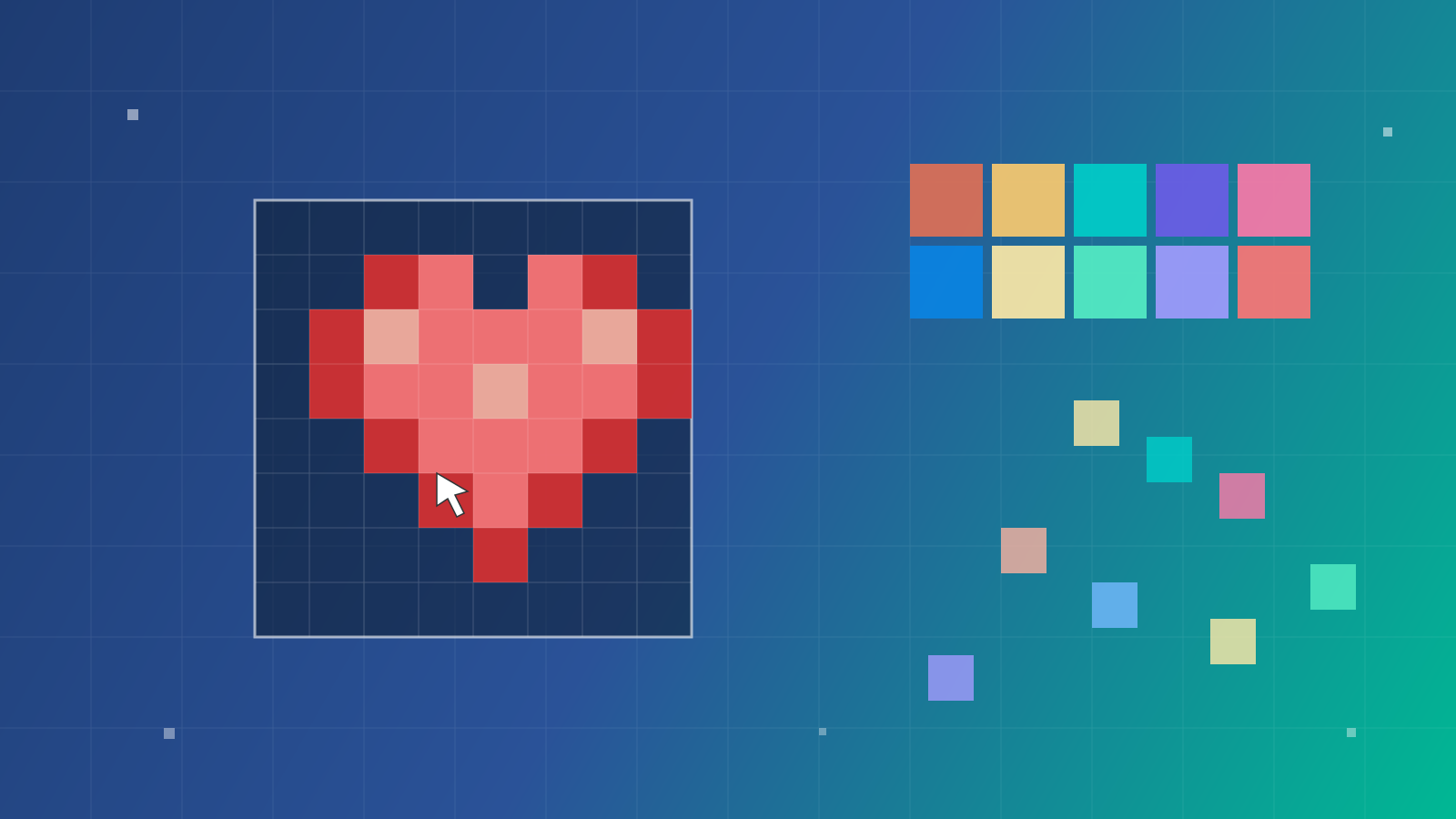
Why a 32-by-32 Square Pulls the Mind In So Deeply
Anyone who has made pixel art remembers the distinct sense of time it produces. "Place one pixel, change the color, place one more"—and yet, unnoticed, two hours have passed. You started at sunset; the window is dark. That time dissolution is not coincidence. Pixel art precisely satisfies the conditions that produce flow.
Born of the harsh resolution limits of the Famicom and Game Boy era, pixel art is getting new attention in an age where smartphones deliver tens of megapixels at a touch—precisely as an on-ramp to creative flow. The tighter the constraints, paradoxically, the deeper the immersion. The heart of flow theory that Csikszentmihalyi underlined repeatedly is concentrated in this craft.
Three Structural Reasons Pixel Art Meets Flow Conditions
1. Clear goals from a finite canvas A 32×32 canvas has only 1,024 cells. "How much to draw to call it done" is physically obvious, and the oil-painting trap of "just a little more?" almost cannot happen. The resolution of the goal arrives pre-set.
2. Instant per-pixel feedback Each pixel you place is rendered immediately on screen. The result appears before the thought "was that right?" finishes. Don't like it? Ctrl+Z in an instant. Few creative practices have a trial-and-error loop this short.
3. Infinite expressive possibility "Only 1,024 cells" nonetheless accommodates characters, landscapes, animation, and abstract work—the expressive range is unlimited. "What to cut, what to imply" becomes the intellectual challenge, and as skill grows, deeper expression becomes possible.
Why "Constraint" Releases Creativity
Faced with a blank canvas and unlimited digital colors, most people freeze. "What should I draw?" "Where do I start?" The classic decision paralysis of abundant choice.
Pixel art structurally dissolves that paralysis. - The canvas is small (16×16 or 32×32). - The palette is limited (8 colors, 16 colors). - The unit of work is one pixel (no ambiguity).
Inside these constraints, people can immerse themselves in the creative problem of "making the most with the least." Constraint is not the enemy of freedom; it is the on-ramp to creative flow.
Three Steps to Start Today
Step 1: Pick one tool The go-to is Aseprite. Paid, but affordable, and loaded with pixel-art-specific features. Free alternatives include Piskel (runs in a browser) and GIMP (zoomed-in per-pixel editing); dotpict is a convenient mobile option.
Choosing quickly and moving your hands beats agonizing over tool choice.
Step 2: Start with a 16×16 small character For a first piece, a simple 16×16 subject works best. - A heart - A sword - Fruit (apple, banana) - A face-like expression
Inside 256 cells, deciding "this cell is this color, this is the shadow, this is the highlight" is, beyond the final look, a form of organizing thought.
Step 3: Limit yourself to 16 colors or fewer Beginners tend to add colors and lose overall cohesion. Decide on a 16-color palette before drawing, and color-choice friction falls, letting work flow.
Emulating famous palettes—a four-color Game Boy-style set, a sixteen-color retro-game palette—is also a good learning exercise.
Three Practices That Deepen Pixel-Art Flow
Practice 1: The 16×16 challenge Draw one 16×16 piece each day. The prompt can be "today's breakfast," "something in front of me," "how I feel right now"—any everyday subject. - Thirty-minute time limit. - Prioritize finishing over polish. - Over time, you accumulate a small personal archive.
Many people post with tags like #pixelart and #pixelart_daily; feedback from a small community fuels the next piece.
Practice 2: Palette-restriction challenges Halve your usual palette. If you draw with 16 colors, try 8. If you use 8, try 4. - Tighter restriction pushes color use toward creativity. - "Express shadow through hue differences," "imply light via color temperature"—advanced technique develops naturally. - Restriction isn't confinement; it is the weight that trains expressive muscle.
Practice 3: The one-piece-a-day habit Daily small work outpaces weekends-only work for pixel-art growth. - Tired days: a quick 16×16 doodle is enough. - Strong days: try 32×32 or 64×64. - Saving files in a dated folder makes the path of growth visible.
Six months in, comparing early pieces to recent ones, the improvement often surprises you.
Three Neurological Benefits of Pixel Art
1. Better spatial reasoning Expressing form at limited resolution constantly forces "what to cut, what to keep" decisions—a training in spatial abstraction. Sustained, it sharpens everyday visual cognition.
2. Refined color sense Because the palette is limited, you become sensitive to each color's personality—"this one is warm," "this one settles." Many practitioners develop near-professional sensitivity to subtle hue differences.
3. Detoxifying perfectionism Because "done" is structurally clear in pixel art, the endless "should I touch it up more?" loop doesn't take hold. Seeing the end lets you immerse without anxiety—a trait not easily found in other creative practices.
Where Pixel Art Fits in Modern Life
As a morning warm-up Fifteen minutes before work, over coffee, finish one tiny pixel piece. As creative warm-up for the brain, it lifts subsequent work performance.
As an evening cool-down Thirty minutes before bed, drop social media and draw pixel art on a tablet. If blue light is a concern, go analog with graph paper and colored pencils. The per-pixel rhythm settles the autonomic nervous system.
As a weekend focus block Dedicate Saturday afternoon—a three-hour pixel-art block—to a larger 64×64 or 128×128 piece. Longer sessions tend to produce deeper flow.
One winter night, stuck on work and unable to sleep after getting into bed, I opened a tablet and drew a 16×16 cat. About thirty minutes of placing colors carried my mind completely away from "the rest of the project," and when I noticed, sleepiness had arrived. Pixel art holds more mind-settling power than people expect.
Shared Flow With Family and Friends
Pixel art doesn't have to be solo.
Parent and child Kids love pixel art. With graph paper and pens, decide together what to draw and take turns filling cells one at a time. The simple game replaces screen time with shared-flow time for parent and child.
Posting and conversing online X (Twitter) and Instagram host large pixel-art communities. Post your work, leave likes, exchange comments. Creation through exchange turns a potentially solitary hobby into a social activity.
Online prompt events Weekly tags like #pixelart_weekly announce themes. Themes pull you toward subjects you would never choose alone, widening expressive range.
What Pixel Art Teaches About "The Richness of Less"
Ours is an era of excess resolution and excess choice. Phone cameras shoot tens of megapixels; streaming services offer millions of titles. In that context, deliberately immersing in a world of just 1,024 cells is, paradoxically, a luxurious way to spend time.
Squeezing the maximum out of constraint—the attitude spreads beyond pixel art into how you approach work, life design, even relationships. "Don't try to do everything," "compete with less"—the thinking begins to settle in through the practice itself.
Tonight, open a free pixel-art tool and look at a 16×16 canvas. From the moment you place the first pixel, the color of your evening shifts. Feeling wide freedom inside a small, constrained world—that is the essence of the flow pixel art offers.
About the Author
FlowState Hub Editorial TeamWe share the science of flow in a way that is easy to understand and applicable to modern life.
View author profile →Related Articles
Flow Through Magic and Sleight-of-Hand Practice: Why Ten Minutes in Front of the Mirror Resets the Mind
Enter Flow Through Mental Math and Abacus Training: How Numbers Pull the Mind Into Immersion
Design Flow With Your Core Body Temperature Rhythm: Tuning Focus From the Inside Out
Borrow Wisdom to Enter Flow: Turning Great Quotes Into Personal Flow Triggers